
Best Crypto Dust Sweepers in 2026
Many crypto dust sweepers clean up one network at a time and pay you out in that network's gas token. Sweep is built for leftovers spread across Ethereum, Base, Arbitrum and other chains. It combines them into one token you choose, on the chain you choose, in a single flow, and shows the quoted output before you sign.
TL;DR
- Most dust converters stop at one chain. Jumper's Dust Sweeper and the converters in OKX, Bitget, Trust Wallet and TokenPocket clean up one network per run. Leftovers on three chains mean three runs and three separate balances.
- Sweep is the cross-chain exception. Sweep combines balances from several EVM chains into one token on the chain you pick, in a single flow, comparing available routes from Relay, Across, Mayan, Symbiosis and Fly.
- You decide what you receive. Most tools pay out the network’s gas token. Sweep lets you pick any supported token, or split the result between two, and deliver it to another chain or to a Solana or Tron address.
- Fewer prompts with batching. When the wallet, account, network and route support batching, Sweep groups eligible calls on each source chain. Account setup, approvals or sequential execution can require extra confirmations.
- See the numbers before you sign. Gas applies on every source chain, so the tiniest balances are not always worth moving. Sweep shows the quoted amount received and flags sweeps with a displayed value loss above 10%.
Not sure what you hold? The free wallet dust scanner lists supported small balances for a public EVM address without connecting a wallet. For a walkthrough, read how to swap crypto dust.
What a crypto dust sweeper does
A dust sweeper turns many small token balances into one usable asset, with fewer steps than swapping each token by hand.
Done manually, every token usually needs an approval and a swap, and each of those pays gas. That is why leftovers pile up after bridging, airdrops and trading.
The tools below differ in three ways: how many chains they clean up per run, which token you receive, and whether you keep custody of your funds.
1. Sweep
Sweep lets you select balances on any of its supported EVM chains at once, choose one or two output tokens and a destination network, and checks eligible routes through its integrations, including Fly for same-chain swaps and other available providers for cross-chain transfers. You see the quoted amount received and quoted costs before you approve.
With wallets that support EIP-5792 batch calls, Batch mode can group eligible approvals and swaps on each source chain. Account setup or sequential execution can still require extra confirmations.
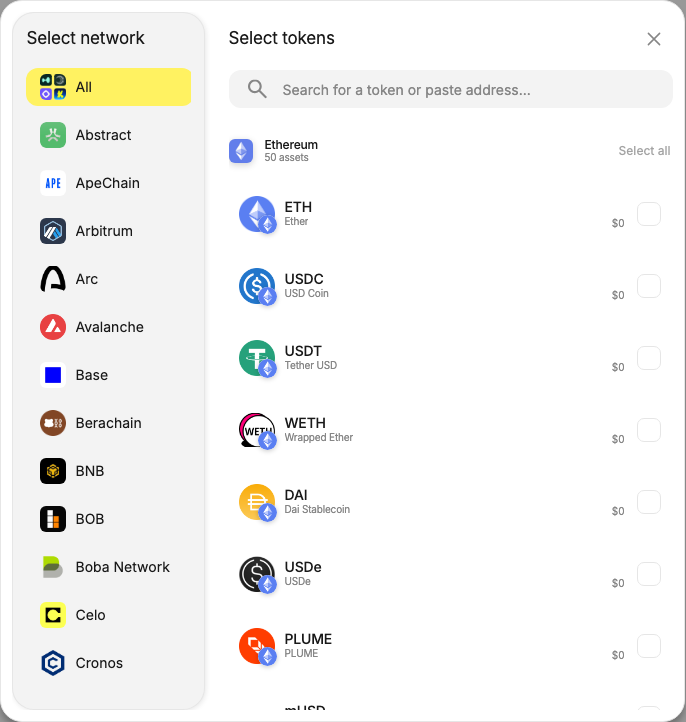
- Chains
- 80+
- Output
- Supported tokens, up to 2
- Prompts
- Wallet- and chain-dependent
- Fee
- 0.15%
- Custody
- Self-custody
Why it stands out
- Combines balances from several EVM chains into the token and destination you choose, for example USDC on Arbitrum.
- Up to two output tokens in one sweep, such as part USDC and part ETH.
- Compares available routes across five provider integrations.
- Batches eligible calls per source chain with compatible wallets.
- Shows the amount received before signing and flags sweeps that lose more than 10% of their value.
- A free scanner finds supported small balances without connecting a wallet.
Best suited for: Anyone with leftovers on two or more EVM chains who wants them in one useful balance.
2. Jumper
Jumper, built on LI.FI, has two relevant features. Dust Sweeper scans for low-value balances and, on the chain you pick, sweeps the selected tokens into that chain’s native asset. After first-time approvals, a sweep is one signed transaction, and tokens that cannot be routed are skipped.
In Jumper Advanced, Multi-swap sells several tokens into one output token in one flow. Jumper’s documentation does not say whether a single Multi-swap can combine tokens from different chains.
- Chains
- 65+
- Output
- Native token
- Prompts
- 1 per sweep
- Fee
- 0.03–0.15%
- Custody
- Self-custody
Strengths
- One signature per sweep after approvals.
- Large routing network: 65+ chains overall.
- Token risk labels from Hypernative.
Limitations
- Dust Sweeper pays out the native token only, one chain at a time.
- Dust Sweeper is described in a LI.FI article rather than Jumper’s product docs.
- Multi-swap’s cross-chain scope is not documented.
Best suited for: Clearing one chain’s leftovers into its gas token.
3. Trust Wallet Dust Cleaner
Trust Wallet launched Dust Cleaner in February 2026. It scans for small balances on supported networks, lets you set a threshold, and blocks cleanups that would return less value than they cost in gas.
On EVM networks the selected dust is processed in one action per network. On Solana it burns the selected dust tokens instead of converting them.
- Chains
- Not listed
- Output
- Not stated
- Batch
- 10 tokens
- Fee
- Not stated
- Custody
- Self-custody
Strengths
- Blocks cleanups that would cost more than they return.
- You set the minimum threshold.
Limitations
- Up to 10 balances per cleanup, one network at a time.
- Supported networks and the output token are not listed.
- Solana mode burns selected tokens rather than swapping them; associated account rent can be recovered.
Best suited for: Trust Wallet users tidying one network at a time.
4. Bitget Wallet Dust Swap
Bitget Wallet’s dust swap (August 2026) converts up to 20 eligible small balances per batch on Solana, BNB Chain, Base and Robinhood Chain. The default output is the network’s native token, with USDT or USDC on BNB Chain, USDC on Base and USDG on Robinhood Chain as options.
Major tokens, stablecoins and staking assets are excluded from dust detection, and tokens without a quote stay in the wallet.
- Chains
- 4
- Output
- Native or stablecoin
- Batch
- 20 tokens
- Fee
- Gas + swap fees
- Custody
- Self-custody
Strengths
- Up to 20 tokens per batch.
- Stablecoin outputs on BNB Chain and Base.
Limitations
- Four networks, one per batch.
- Excludes stablecoins and major tokens from dust.
- Swap fees and slippage can apply on top of gas.
Best suited for: Bitget Wallet users with many small tokens on one of its four networks.
5. OKX Wallet Dust Converter
OKX Wallet’s Dust Converter swaps tradable tokens with balances between $0.001 and $10 into the network’s native token in one transaction. It currently supports Solana only, and only for seed-phrase wallets with Trader Mode enabled.
- Chains
- 1 (Solana)
- Output
- Native token
- Prompts
- 1 signature
- Fee
- Network fee
- Custody
- Self-custody
Strengths
- One signature per conversion.
- A published definition of dust ($0.001–$10).
Limitations
- Solana only at the time of writing.
- Native-token output only.
- Requires Trader Mode and a seed-phrase wallet.
Best suited for: OKX Wallet users clearing Solana leftovers into SOL.
6. TokenPocket Dust Cleaner
TokenPocket’s Dust Cleaner converts eligible small balances into one receive token you select, on Ethereum, BNB Chain, Base and Arbitrum. Balances under $0.10 may not convert, and you need the network’s native token for gas.
- Chains
- 4
- Output
- Chosen token
- Minimum
- $0.10
- Fee
- Not stated
- Custody
- Self-custody
Strengths
- You choose the receive token.
- Covers four major EVM networks.
Limitations
- One chain per run.
- Fees and the number of transactions are not stated.
Best suited for: TokenPocket users cleaning up one EVM chain.
7. Exchange small-balance converters
Most large exchanges convert leftover spot balances inside your account. On Binance.US, “Convert Small Balances” turns holdings worth under $20 each into BNB, BTC, ETH or USDT, with a small fee shown before you confirm. They only see what is already in your exchange account.
- Chains
- n/a
- Output
- BNB, BTC, ETH, USDT
- Eligible
- Under $20
- Fee
- Small fee
- Custody
- Custodial
Strengths
- No gas: nothing moves on-chain.
- Many assets in one click.
Limitations
- Custodial: the exchange holds the assets.
- Wallet tokens would have to be deposited first.
- Output limited to a few assets.
Best suited for: Leftovers from trading on an exchange that you do not plan to withdraw.
Crypto dust sweeper comparison
Batch support means several tokens are converted in one confirmation or transaction. Multi‑asset means many tokens from several chains in one flow, delivered as one or two tokens you choose. Pick output means you choose the token you receive. Aggregator means it compares routes from several liquidity providers.
| Tool | Batch support | Multi-asset | Pick output | Aggregator | Chains |
|---|---|---|---|---|---|
| Sweep (our top pick) | Yes: eligible source-chain calls can be batched when the wallet, account and route support it | Yes: many tokens on several EVM chains in one flow, out as one or two tokens | Yes: any supported token, or two | Yes: compares Relay, Across, Mayan, Symbiosis and Fly | 80+ |
| Jumper | Yes: one signed transaction per sweep after approvals | Not documented: Multi-swap takes several tokens into one; whether it spans chains is not documented | Yes: in Multi-swap; Dust Sweeper pays out the native token | Yes: LI.FI routing across DEXs and bridges | 65+ |
| Trust Wallet | Yes: up to 10 balances in one action per network | No: several tokens, but one network per action | Not documented: output token not stated | Not documented: routing not documented | Not documented: supported networks not listed |
| Bitget Wallet | Yes: up to 20 tokens per batch | No: several tokens, but one network per batch | Partly: native token or listed stablecoins | Not documented: routing not documented | 4 |
| OKX Wallet | Yes: one transaction per conversion | No: several tokens, Solana only | No: native token only | Yes: trades through OKX DEX | 1 |
| TokenPocket | Not documented: number of transactions not stated | No: several tokens, but one chain per run | Yes: one chosen token | Not documented: routing not documented | 4 |
| Exchange converters | Yes: many balances in one click, off-chain | No: exchange balances only | Partly: BNB, BTC, ETH or USDT | No: the exchange’s own liquidity | n/a |
Leftovers on more than one chain? Sweep turns them into one token in a single flow: pick the balances, choose what you want to receive, and review the quoted amount before you sign.
Sweep your dust nowCrypto dust sweeper FAQ
Try Sweep: Consolidate Your Assets Across Chains
Stop leaving value scattered across chains. Select supported leftover balances on your EVM networks, choose the token and chain you want, and Sweep compares available routes across its five integrations. You see the quoted amount received before you sign.
- All your chains in one flow.
- Any supported output token, or two.
- Wallet batching for eligible source-chain calls.
How we ranked these tools
Sweep publishes this guide and is one of the tools compared.
We read each product’s official documentation, help pages or launch posts between 23 and 27 October 2026, recorded what is published, and marked anything unpublished as “not stated”. Nobody paid for placement. For Sweep we also checked its source code and the production app.
- Consolidation scope. One chain per run, or several chains in one flow, as documented.
- Output control. Native token only, a short list, or a token and destination chain you choose.
- Documented coverage. Networks named in official documentation.
- Batch size and prompts. Maximum tokens per run and documented signatures or approvals.
- Economic safeguards. Documented gas-versus-value checks, thresholds, partial-failure handling and token risk labels.
- Fees. Published platform fee for the feature, or “not stated”.
- Custody. Self-custody wallet or exchange account.
Consolidation scope and output control carry the most weight, because turning leftovers into something usable is the job. Ties are broken by safeguards, then documented coverage. Sweep ranks first because it is the only tool here documented to combine several chains in one flow.
What we left out
- Odos: its site says trading ended on 27 July 2026 and its API on 30 July 2026.
- DustSweeper (dustsweeper.xyz): its site says it is deprecated.
- Rabby “Convert Dust”: described only in social posts; none of Rabby’s 60 most recent GitHub releases mention it.
- Binance Wallet dust conversion: covered only by secondary sources; we found no official page.
Sources
Features, fees and supported networks change, so confirm them in each product before you transact.
- Sweep app
- Sweep: How to swap crypto dust
- Sweep: Batch crypto transactions
- Sweep wallet dust scanner
- LI.FI: How Jumper uses LI.FI Composer to turn wallet dust into usable liquidity
- Jumper docs: Advanced (Multi-swap)
- Jumper docs: Jumper fees
- Jumper docs: Swap and bridge overview
- Trust Wallet: Dust Cleaner
- Bitget Wallet: Dust swap
- OKX Wallet help: Dust converter
- TokenPocket help: Dust Cleaner
- Binance.US: Convert small balances and crypto dust
- Odos: service wind-down notice
- EIP-5792: Wallet call API
- ethereum.org: Gas and fees