
Best Crypto Swap Platforms in 2026
Most crypto swap platforms trade one pair at a time: one token in, one token out. Sweep is built for the bigger job. Select tokens on Ethereum, Base, Arbitrum and other chains, and it swaps them into one or two tokens you choose, on the chain you choose, in a single flow, comparing available routes across five provider integrations and showing the quoted output before you sign.
TL;DR
- Most platforms swap one pair at a time. Uniswap, 1inch, Relay, Across and the others here quote one token into one token per swap, so ten tokens mean ten swaps and often ten approvals. Jumper documents multi-token swaps; whether one run combines source chains is not stated.
- Sweep swaps across chains in one flow. Select tokens on several EVM chains and Sweep turns them into one or two tokens on the chain you pick, comparing available routes from Relay, Across, Mayan, Symbiosis and Fly.
- You decide what you receive, and where. Pick any supported token, or split the result between two, and deliver it to another EVM chain or to a Solana or Tron address.
- Fewer prompts with batching. When the wallet, account, network and route support batching, Sweep groups eligible calls on each source chain. Account setup, approvals or sequential execution can require extra confirmations.
- Every fee before you sign. Sweep shows the quoted amount received and every fee in the route, including its own 0.15%, before you approve. Gas applies on each source chain.
Swapping several tokens at once? Read how to swap many tokens into one asset, or compare indicative outputs first in the cross-chain route explorer.
What a crypto swap platform does
A swap platform trades one token for another from your own wallet. Four kinds of products sit behind the same “swap” button, and they are not interchangeable.
A DEX such as Uniswap trades against its own liquidity pools. An aggregator such as 1inch or OKX DEX searches many DEXs for the best combined price. Cross-chain apps such as Jumper, Relay and Across also move your tokens to another network.
Multi-asset swap apps such as Sweep take many tokens, possibly on several chains, and deliver one or two outputs in a single flow.
1. Sweep
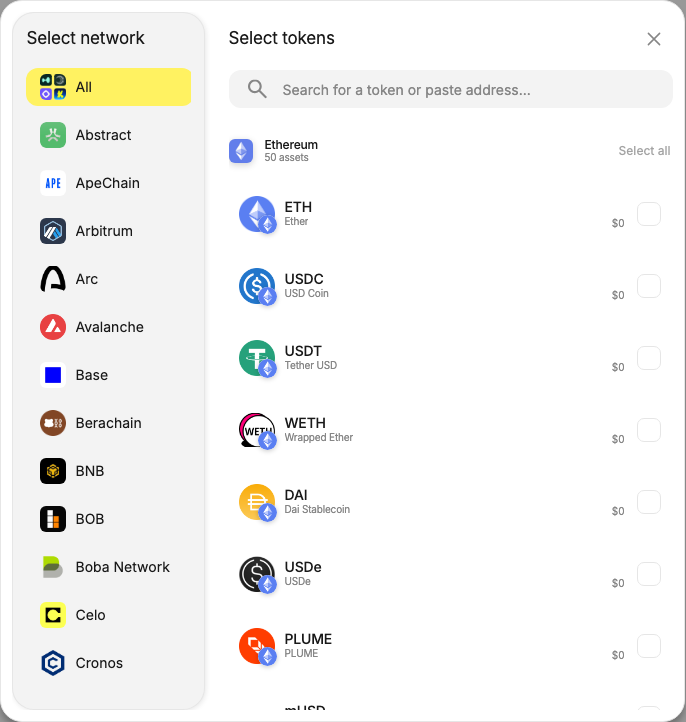
Sweep is a multi-asset swap app. Select tokens on one or several EVM chains, choose one or two output tokens and a destination network, and Sweep quotes each leg through Relay, Across, Mayan and Symbiosis for cross-chain routes or Fly for same-chain swaps. You see the quoted amount received and quoted costs before you approve.
A one-to-one swap is the smallest case of the same flow. With wallets that support EIP-5792 batch calls, Batch mode can group eligible approvals and swaps on each source chain. Account setup or sequential execution can still require extra confirmations.
- Type
- Multi-asset swap app
- Chains
- 80+
- Platform fee
- 0.15%
- Routing
- 5 providers
Why it stands out
- Swaps tokens from several EVM chains into one or two outputs in one flow, for example USDC on Arbitrum.
- Compares available routes across five provider integrations.
- Batches eligible calls per source chain with compatible wallets.
- Delivers to another EVM chain or to a Solana or Tron address.
- Shows the amount received and quoted costs before you sign.
Best suited for: Consolidating, rebalancing or moving several tokens across chains into one or two assets.
2. Jumper
Jumper is LI.FI’s consumer app. Its MetaDex aggregator sources same-chain liquidity from 33+ DEXs, and cross-chain swaps choose among 30+ bridge providers across 65+ chains, ranked on output, time, cost and availability. Jumper Advanced adds limit orders (routed to CoW, 1inch and Velora), TWAP, exact-output swaps and a Multi-swap mode that sells several tokens into one output token.
Gas Top Up can add a little native gas on the destination chain, and tokens carry Hypernative risk labels.
- Type
- Cross-chain aggregator
- Chains
- 65+
- Platform fee
- 0–0.05%
- Routing
- 33+ DEXs, 30+ bridges
Strengths
- Published fees: 0% for stable swaps, 0.02% for majors and 0.05% for other tokens.
- Broad coverage across DEXs, bridges and chains in one interface.
- Multi-swap and a per-chain Dust Sweeper for consolidation on one chain.
Limitations
- Multi-swap carries a higher fee (0.03–0.15%), and its cross-chain scope is not documented.
- Route quality depends on the underlying bridge or DEX chosen.
Best suited for: Everyday swaps on or across chains when you want one interface and low platform fees.
3. Relay
Relay is a cross-chain payments and swap protocol with its own app and API. Solvers fill orders on the destination chain, and its documentation lists 59 mainnets, including Bitcoin and Solana.
Its platform fee is published by pair type: 0.00% for token bridging, 0.01% for stablecoin swaps, 0.06% for major swaps and 0.15% for minor swaps, plus an execution cost of $0.02 and the destination gas estimate.
- Type
- Cross-chain protocol
- Chains
- 59
- Platform fee
- 0–0.15% + $0.02
- Execution
- Solver fills
Strengths
- Transparent per-pair fee table.
- Same-chain and cross-chain swaps in the same API.
- Bitcoin, Solana, Tron and TON alongside EVM chains.
Limitations
- One origin per quote: no many-to-one swaps.
- Minor-token swaps cost 0.15% before gas and price impact.
Best suited for: Moving between EVM chains quickly when you want to know the fee before you start.
4. Rango
Rango aggregates bridges, DEXs and DEX aggregators across 75 active blockchains on its integrations list, including Cosmos chains, Bitcoin, Litecoin, Dogecoin, Solana, Tron, Starknet, TON and Sui. Routes can chain several swappers together.
Rango states that its app at app.rango.exchange charges no fee of its own; network gas and the fees of the underlying swappers still apply.
- Type
- Cross-chain aggregator
- Chains
- 75
- Platform fee
- 0% app fee
- Routing
- Bridges, DEXs, aggregators
Strengths
- The widest non-EVM coverage in this list.
- Zero app fee published for app.rango.exchange.
- Multi-step routes reach pairs that a single bridge cannot.
Limitations
- Multi-step routes can involve more than one confirmation.
- No many-to-one swaps.
- Swapper fees vary by route and are taken by those protocols.
Best suited for: Swaps that touch Cosmos, UTXO chains, TON or Sui as well as EVM.
5. Bungee
Bungee is the Socket team’s first-party swap app. Socket routes transfers across 30+ networks through bridges, DEX aggregators and other venues, and its docs describe Refuel, which adds destination-chain gas during a swap, plus exact-output quoting.
Socket’s documentation says it charges users no additional fees: execution costs are inside the quoted amount.
- Type
- Cross-chain aggregator
- Chains
- 30+
- Platform fee
- No added fee
- Extras
- Refuel, exact output
Strengths
- No added platform fee, per Socket.
- Refuel for arriving on a chain without gas.
- Exact-output quotes when you need a specific amount.
Limitations
- No many-to-one swaps.
Best suited for: Bridging to a new chain where you also need gas on arrival.
6. OKX DEX
OKX DEX is the aggregator inside OKX Wallet. OKX’s 2026 user guide says it aggregates 400+ DEXs and 25+ bridges, supports trading on 26 chains and cross-chain swaps on 17.
OKX publishes a tiered interface fee that depends on the token groups being traded, from 0% on some pairs up to 0.5%.
- Type
- DEX aggregator
- Chains
- 26 (17 cross-chain)
- Platform fee
- 0–0.5%
- Routing
- 400+ DEXs, 25+ bridges
Strengths
- Large liquidity-source count across many chains.
- Built into OKX Wallet, alongside a Solana dust converter.
Limitations
- Interface fee of up to 0.5% on some pairs.
- Cross-chain swaps on fewer chains (17) than same-chain trading.
Best suited for: People who already hold assets in OKX Wallet.
7. deBridge
deBridge’s DLN is a zero-TVL, intent-based network: you lock funds in an order and a solver fulfils it on the destination chain. Its fee table lists 18 chains, including Solana, Tron, HyperEVM and Injective.
Every order pays a flat fee in the source chain’s native token (0.001 ETH on Ethereum, Arbitrum and Base) and a 4 bps protocol fee, with a solver margin of about 4 bps built into the quote. Both protocol fees are refunded if the order is cancelled.
- Type
- Intent network
- Chains
- 18
- Platform fee
- Flat fee + 0.04%
- Execution
- Solver fills, zero TVL
Strengths
- Fully published fee model, refundable on cancellation.
- Solana and Tron in the same network as major EVM chains.
Limitations
- The flat fee weighs heavily on small swaps.
- Fewer chains than the large aggregators.
- No many-to-one swaps.
Best suited for: Larger cross-chain swaps, especially to or from Solana or Tron.
8. Uniswap
Uniswap is the largest pool-based DEX. Uniswap Labs set its interface, wallet and API fees to zero as part of the UNIfication proposal, so you pay pool fees, gas and price impact only.
Since 4 June 2026 the web app also swaps across chains in a single action, using Across and the Uniswap Protocol, on Ethereum, Unichain, Arbitrum One, Base, Optimism, World Chain, zkSync, Zora, Linea, Soneium and MegaETH. The same update added a passkey in-app wallet.
- Type
- DEX
- Chains
- 11 cross-chain
- Platform fee
- 0% interface fee
- Routing
- Uniswap + Across
Strengths
- No interface fee from Uniswap Labs.
- Deep liquidity for major pairs.
- Cross-chain swaps without leaving the app on supported networks.
Limitations
- Cross-chain swaps only between the listed networks.
- One pair at a time.
- Pool fees still apply to every trade.
Best suited for: Straightforward swaps of major tokens on Ethereum and its large L2s.
9. 1inch
1inch offers three execution modes in its Swap API: Classic aggregated swaps, intent-based swaps filled by competing resolvers, and cross-chain swaps. Its documentation lists 18 chains; Classic is not available on Solana.
Intent-based and cross-chain swaps are gasless and MEV-protected, according to 1inch. In the Swap interface resolvers usually cover gas, except on Solana, from native tokens and for very small swaps. 1inch says infrastructure fees may apply but does not publish a percentage.
- Type
- DEX aggregator
- Chains
- 18
- Platform fee
- Not published
- Modes
- Classic, intent, cross-chain
Strengths
- Gas usually covered in the Swap interface.
- MEV protection on intent and cross-chain swaps.
- Aggregated Classic routing for full control.
Limitations
- No published fee percentage.
- No many-to-one swaps.
- Classic mode, where you pay gas, is unavailable on Solana.
Best suited for: Same-chain swaps where you would rather not hold gas or worry about MEV.
10. Across
Across is an intent-based bridge whose relayers fill transfers on the destination chain, with fills of about two seconds across 23+ chains, according to its docs. Its Swap API handles the swap into a bridgeable token as part of the transfer, and Across powers cross-chain swaps in the Uniswap web app.
- Type
- Intent bridge
- Chains
- 23+
- Platform fee
- No app fee
- Execution
- Relayer fills
Strengths
- Fills in about two seconds, per its docs.
- Fee components (LP, relayer, gas and capital) are documented.
- Persistent deposit addresses for repeated transfers.
Limitations
- Same-chain swaps are not documented: it is a cross-chain tool.
- Fewer chains (23+) than the big aggregators.
- No many-to-one swaps.
Best suited for: Moving assets between major chains, including inside Uniswap.
Crypto swap platform comparison
Same-chain and Cross-chain mean a swap on one network, or into another. Multi‑asset means many tokens from several chains in one flow, delivered as one or two tokens you choose. Aggregator means it compares routes from several liquidity providers. Chains counts the networks each platform documents.
| Tool | Same-chain | Cross-chain | Multi-asset | Aggregator | Chains |
|---|---|---|---|---|---|
| Sweep (our top pick) | Yes: same-chain routes through Fly or Relay | Yes: to any supported EVM chain, or a Solana or Tron address | Yes: many tokens on several EVM chains in one flow, out as one or two tokens | Yes: compares Relay, Across, Mayan, Symbiosis and Fly | 80+ |
| Jumper | Yes: MetaDex across 33+ DEXs | Yes: 30+ bridges across 65+ chains | Not documented: Multi-swap takes several tokens into one; whether it spans chains is not documented | Yes: LI.FI routing across DEXs and bridges | 65+ |
| Relay | Yes: same-chain and cross-chain in one API | Yes: solver fills on the destination chain | No: one origin per quote | Not documented: fills through its own solvers; DEX sourcing not documented | 59 |
| Rango | Yes: DEXs and aggregators on each chain | Yes: multi-step routes across 75 chains | No: one token per swap | Yes: bridges, DEXs and DEX aggregators | 75 |
| Bungee | Yes: through Socket routing | Yes: 30+ networks, with Refuel | No: one token per swap | Yes: Socket routes through bridges and DEX aggregators | 30+ |
| OKX DEX | Yes: trading on 26 chains | Yes: cross-chain swaps on 17 chains | No: one pair per swap | Yes: 400+ DEXs and 25+ bridges | 26 |
| deBridge | Yes: same-chain swaps in its API | Yes: 18 chains, including Solana and Tron | No: one order per swap | Not documented: solver network; DEX sourcing not documented | 18 |
| Uniswap | Yes: Uniswap pools | Yes: since June 2026, on 11 networks via Across | No: one pair at a time | No: Uniswap pools, with Across for cross-chain | 11 |
| 1inch | Yes: Classic and intent modes | Yes: gasless cross-chain mode | No: one pair per swap | Yes: aggregated Classic routing | 18 |
| Across | Not documented: same-chain swaps not documented | Yes: relayer fills in about two seconds | No: one transfer at a time | No: its own relayer network | 23+ |
Holding tokens on more than one chain? Sweep swaps them into one or two tokens in a single flow: pick the balances, choose what you want to receive, and review the quoted amount before you sign.
Swap with Sweep nowCrypto swap platform FAQ
Try Sweep: Consolidate Your Assets Across Chains
Stop swapping one token at a time. Select balances on your EVM chains, choose the token and chain you want, and Sweep compares available routes across its five integrations. You see the quoted amount received before you sign.
- All your chains in one flow.
- Any supported output token, or two.
- Wallet batching for eligible source-chain calls.
How we ranked these platforms
Sweep publishes this guide and is one of the platforms compared.
We defined three jobs: a same-chain swap, a cross-chain swap such as ETH on Ethereum to USDC on Arbitrum, and many tokens on several chains into one, such as eight tokens on three chains into USDC on Arbitrum. For each platform we read the official documentation and fee pages between 23 and 27 October 2026. Nobody paid for placement. For Sweep we also checked its source code and the production app.
- Job coverage. How many of the three jobs the platform completes natively in one flow, as documented.
- Published fees. Whether a platform fee schedule is published, and its value.
- Documented chains. Chain count from official documentation.
- Prompts and execution model. Approvals, signatures and gasless or intent modes, as documented.
This is an editorial ranking that prioritizes job coverage, then weighs fee transparency, network coverage and execution model. Sweep is our top pick for combining supported balances across chains; the other placements are not a mechanical score or a chain-count sort. A higher position does not mean a lower price: for a single swap, Sweep adds a 0.15% fee to the provider route, and a platform further down the list can return more.
What we left out
- Custodial exchanges and instant-exchange services (different custody model).
- CoW Swap, Matcha, Squid’s app and THORChain: not re-verified in this pass; scheduled for the next review.
- Odos: its site says trading ended on 27 July 2026 and its API on 30 July 2026.
Sources
Features, fees and supported networks change, so confirm them in each product before you transact.
- Sweep app
- Sweep: Swap many tokens into one asset
- Sweep: Batch crypto transactions
- Jumper docs: Swap and bridge overview
- Jumper docs: Advanced
- Jumper docs: Jumper fees
- Relay docs: Cost and fee structure
- Relay docs: Supported chains
- Rango docs: Integrations (supported blockchains)
- Rango docs: Fee structure
- Socket docs: How to integrate Socket (Bungee)
- Socket docs: Fees and monetization
- Socket docs: Bridging
- Socket docs: Refuel
- OKX help: OKX DEX user guide (web)
- OKX: DEX service fee
- deBridge docs: Fees and supported chains
- deBridge docs: Fee structure
- Uniswap Labs blog: In-app wallet, crosschain swaps and portfolio tracking (4 June 2026)
- Uniswap Labs blog: UNIfication (10 November 2025)
- 1inch Business: Swap API
- 1inch help: Do I pay fees when using 1inch?
- Across docs: Introduction
- Across docs: Fees in the system
- EIP-5792: Wallet call API