
Best Cross-Chain Deposit APIs & Widgets in 2026
Most cross-chain deposit APIs fund a deposit from one asset on one chain, but users rarely hold their money that way. Sweep’s External API funds one deposit from up to 50 assets across EVM chains and settles it as the token your app needs, or two, while your backend keeps control through signed requests, idempotency keys and webhooks. Your users deposit what they hold in one flow, inside your own UI.
TL;DR
- Most deposit APIs take one asset per deposit. LI.FI, Relay, deBridge, Rango, Socket, Squid and NEAR Intents quote one source asset at a time. A user with balances on four chains needs four deposits.
- Sweep funds one deposit from many assets. Its External API takes 1–50 source assets across EVM chains in one intent and settles them as one or two tokens. Avail Nexus also funds from several chains, client-side and into a single token.
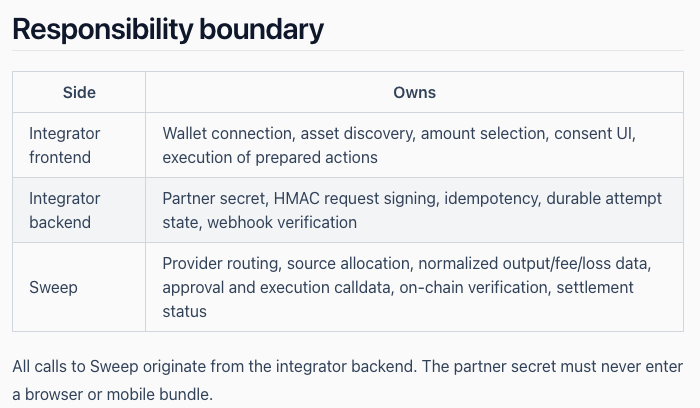
- Your backend stays in control. Sweep is server-side: HMAC-signed requests, idempotency keys, a status endpoint and webhooks with per-leg settlement. Your wallet executes the prepared chain actions, batched with EIP-5792 where supported.
- Earn on every deposit. Sweep lets you add your own markup up to a per-partner cap, 300 bps by default. Elsewhere, LI.FI adds a 0.25% fee under yours and Squid keeps half of integrator fees.
- Access is by request. There is no self-serve signup: message the team, receive staging and production credentials, and verify them with a signed ping.
Building multi-asset deposits into a wallet? Sweep’s integrator docs walk through the quote, prepare, submit and status flow, and the batch transactions guide explains how EIP-5792 wallets group calls per chain.
What a cross-chain deposit API does
A cross-chain deposit API lets users deposit from any chain: it funds your app on one chain with assets held elsewhere and delivers the token your app needs. It replaces the detour where users leave to bridge and swap, and many never come back.
Routing APIs and SDKs return quotes, transactions and status. Widgets render the flow inside your app. Deposit addresses let users simply send funds to an address.
Multi-source APIs such as Sweep go further: they fund one deposit from several assets on several chains, so users can deposit what they hold in one flow.
1. Sweep External API
Sweep’s External API is a server-side intent API for partner wallets and apps. Your backend requests a quote for 1–50 source assets across EVM chains and one target token, or two; Sweep allocates them across Relay, Across and Mayan routes; and prepare returns ordered chain actions plus an authorization the user signs, as calls[] for EIP-5792 batching or plain transactions[].
You report the wallet’s execution evidence, then follow settlement through a status endpoint and webhooks, with per-leg results marked as actual or estimated amounts. Requests are HMAC-signed from your backend, mutating calls need idempotency keys, and the OpenAPI contract is public.
- Multi-source
- Yes, 1–50 assets
- Settlement
- One or two tokens
- Delivery
- Recipient address
- Fees
- Your markup, cap 300 bps
- Access
- Partner registration
Why it stands out
- Up to 50 source assets per intent, settled as one or two tokens.
- Server-side control: HMAC-signed requests, idempotency keys and webhooks.
- Per-chain wallet actions, as EIP-5792
calls[]or plain transactions. - Per-leg settlement status, marked as actual or estimated amounts, with optional partial plans.
- Official TypeScript SDK (
sweep-external-sdk, MIT).
Best suited for: Wallets, exchanges and apps adding a native “deposit everything” flow they control end to end.
2. Avail Nexus
Avail Nexus is a chain-abstraction SDK with prebuilt React widgets. Its FastBridge documentation describes multi-source swaps: several different tokens from several EVM chains, received as a single token at the destination in one transaction, with gas payable in stablecoins.
The Deposit widget runs in exact-output mode: the user enters the amount your app should receive and picks sources, and the widget can call your deposit contract on arrival through swapAndExecute. Each intent itemizes a protocol fee, a solver fee and chain-abstraction gas.
- Multi-source
- Yes
- Surfaces
- SDK, widgets
- Coverage
- 12 EVM chains
- Fees
- Protocol + solver + gas
- Routing
- Nexus solvers, Mayan
Strengths
- Funds one deposit from balances on several chains.
- Can deposit straight into your contract on arrival.
- Ready-made widget plus a lower-level SDK.
- Settlement in about 10–20 seconds, according to its docs.
Limitations
- FastBridge lists 12 supported chains, all EVM.
- Client-side SDK; the docs describe no server API or webhooks.
- SDK analytics (PostHog) are on by default; disable them in the client config.
@avail-project/widgetsdeclares UNLICENSED on npm, so check the terms.
Best suited for: Apps that want a ready-made deposit UI funded from several chains, including deposits straight into a contract.
3. Relay
Relay’s single quote endpoint covers bridges, swaps and cross-chain calls across 59 mainnets, including Bitcoin, Solana, Tron and TON. Relay Kit adds an SDK, React hooks and an embeddable swap and bridge widget, and deposit addresses let users send funds without connecting a wallet, with refunds to the depositor when you set a refund address.
Platform fees run from 0.00% for bridging to 0.15% for minor-token swaps, plus a $0.02 execution cost. Your app fees accrue in an off-chain USDC balance; a share of Relay’s own fee needs KYB and more than $10M in trailing 30-day volume.
- Multi-source
- No
- Surfaces
- API, SDK, UI kit
- Coverage
- 59 mainnets
- Fees
- 0–0.15% + $0.02
Strengths
- Bitcoin, Solana, Tron and TON alongside 50 EVM chains.
- Destination calls through the same quote API.
- Deposit addresses, with optional refunds.
Limitations
- One origin per quote.
- Revenue share only at high volume.
- Relay’s npm packages do not declare a license field.
Best suited for: Apps that want one provider for many chains, plus deposits from users who will not connect a wallet.
4. LI.FI
LI.FI aggregates bridges, DEX aggregators, intent solvers and DeFi protocols across 58+ chains, including Solana, Bitcoin, Sui, Tron, Stellar and Zcash. You can integrate through the REST API, the TypeScript SDK or the embeddable widget, both at major version 4 since April 2026, and Composer turns a quote into a deposit when the destination token is a supported vault or staking token on EVM chains.
LI.FI charges a 0.25% service fee per transaction, with volume discounts, and you can add your own. Without an API key the API allows 200 requests per two hours; with one, 200 per minute.
- Multi-source
- No
- Surfaces
- API, SDK, widget
- Coverage
- 58+ chains
- Fees
- 0.25% + your fee
Strengths
- SDK and widget under Apache-2.0.
- Composer deposits into 20+ protocols on EVM chains.
- Broad non-EVM coverage and a status endpoint.
Limitations
- A 0.25% LI.FI fee sits under your markup.
- Composer works on EVM chains and tokenized positions only.
- One source asset per quote.
Best suited for: Teams that want a mature widget now and the option to drop to the SDK later.
5. deBridge
deBridge’s DLN API creates cross-chain orders that solvers fill on the destination chain, across the 18 chains in its fee table, including Solana, Tron and HyperEVM. Hooks attach on-chain actions to an order so funds can be deposited into a protocol during fulfilment, and an iframe widget with a configuration builder covers the UI.
Each order pays a flat fee in the source chain’s native token plus 4 bps, both refundable if the order is cancelled, and solvers build a margin of about 4 bps into the quote. Integrators can add an affiliate fee.
- Multi-source
- No
- Surfaces
- API, widget, hooks
- Coverage
- 18 chains
- Fees
- Flat fee + 0.04%
Strengths
- Deposit-on-behalf through hooks.
- Solana and Tron alongside EVM chains.
- Refundable protocol fees and a widget builder.
Limitations
- Hook targets must accept a beneficiary parameter, such as Aave’s
onBehalfOf. - The flat fee weighs on small deposits.
- One source asset per order.
Best suited for: Lending and yield protocols whose deposit function credits a beneficiary.
6. Rango
Rango offers a single-step Basic API, a multi-step Main API, a TypeScript SDK, an embeddable widget and a mobile SDK, covering 75 active blockchains on its integrations list, from Cosmos and UTXO chains to Solana, Tron, TON and Sui.
Its protocol charges 15 bps alongside the affiliate fee you configure, which defaults to 10 bps.
- Multi-source
- No
- Surfaces
- API, SDK, widget
- Coverage
- 75 chains
- Fees
- 15 bps + affiliate fee
Strengths
- Non-EVM breadth no other provider here matches.
- Widget and mobile SDK as well as APIs.
- Configurable affiliate fee.
Limitations
rango-sdkis GPL-3.0 (the widget package is MIT).- A 15 bps Rango fee on top of yours.
- Destination execution is not documented; one source per swap.
Best suited for: Apps whose users hold assets on Cosmos, Bitcoin-family chains or TON.
7. Socket
Socket, the team behind Bungee, offers a routing API, a React widget (@socket.tech/widget) and deposit addresses. Its checkout flow lets your app fix the destination token and chain while users pay with assets they already hold, and deposit addresses cover EVM chains plus non-EVM flows such as Solana, Tron, Stellar and HyperCore.
Socket says it adds no markup for users and no API fee for integrators; you can add your own feeBps (it asks you to request API access first) and track deposits with its status endpoint.
- Multi-source
- No
- Surfaces
- API, widget, addresses
- Coverage
- 30+ networks
- Fees
- No Socket fee
Strengths
- No Socket fee.
- Deposit addresses that include non-EVM origins.
- A documented checkout use case.
Limitations
- One asset per deposit.
- Multi-step destination actions (“Zaps”) are listed as coming soon.
Best suited for: Exchanges and apps taking deposits from users who send from other wallets or exchanges.
8. Squid
Squid’s Deposit Widget (@0xsquid/deposit-widget) is a drop-in React component for React 18 or 19, Next.js and Vite. You fix the destination chain and token, and users deposit any token from any chain Squid routes, including EVM, Cosmos, XRPL, Bitcoin and Solana. It has a deposit mode and a fixed-amount payment mode, with branding, route preview and progress screens built in.
Squid splits integrator fees 50/50 and asks you to contact the team to set fees up.
- Multi-source
- No
- Surfaces
- API, SDK, 2 widgets
- Coverage
- EVM, Cosmos, XRPL, Bitcoin, Solana
- Fees
- 50/50 fee split
Strengths
- Built specifically for deposits and payments.
- Cosmos, XRPL and Bitcoin as source chains.
- Payment mode for fixed-amount checkouts.
Limitations
- Half of your integrator fee goes to Squid.
- React-only widget.
- One source asset per deposit.
Best suited for: Apps that want a branded deposit or payment widget live quickly.
9. NEAR Intents 1Click
The 1Click Swap API is a REST API on NEAR Intents: it requests quotes from competing market makers, gives the user a quote-specific deposit address, and tracks execution, with retries and refunds handled for you. 1Click does not take custody of funds.
SDKs exist for TypeScript, Go and Rust, authenticated access uses API keys, and fee collection is set with a single quote parameter.
- Multi-source
- No
- Surfaces
- REST API, SDKs, addresses
- Coverage
- Not reviewed
- Fees
- Configurable
Strengths
- Deposit addresses with no wallet connection.
- Market makers compete on price.
- Refund handling built in.
Limitations
- One source asset per quote.
- Use is subject to the 1Click terms of service.
- We did not review its chain coverage in this pass.
Best suited for: Apps that want simple “send here” deposits with intent pricing.
10. Fun.xyz
Fun.xyz sells deposit, withdrawal, checkout and orchestration infrastructure for crypto and fiat. Its Deposit product is an in-app modal: users deposit any token “on every popular blockchain” or pay with 50+ payment methods, and your app receives the token or fiat currency you specify.
Its developer documentation requires a login, and its React SDK, @funkit/connect, is in closed beta according to its README, so this entry relies on Fun’s public site and npm. Access starts with a contact form.
- Multi-source
- Not stated
- Surfaces
- Modal, SDK (closed beta)
- Coverage
- Not listed
- Fees
- Not published
- Access
- Contact form
Strengths
- Crypto and fiat deposits in one modal, with 50+ payment methods.
- Withdrawals, checkout and orchestration from the same provider.
- Every transaction is screened by third-party compliance vendors, per its site.
Limitations
- Developer docs require a login, so integration details could not be verified.
- The SDK is in closed beta; access starts with a contact form.
- No public fee schedule or chain list.
- Funding one deposit from several assets is not stated publicly.
Best suited for: Consumer apps that want crypto and fiat deposits in one hosted flow and accept a sales-led onboarding.
Cross-chain deposit API comparison
Multi-source means one deposit funded from several assets or chains. Multi-output means one deposit can settle as more than one token. Server API means a REST API your backend calls with its own credentials. Integrator fee means you can add your own fee.
| Tool | Multi-source | Multi-output | Server API | Integrator fee |
|---|---|---|---|---|
| Sweep External API (our top pick) | Yes: 1–50 source assets across EVM chains per intent | Yes: one or two settlement tokens per intent | Yes: HMAC-signed REST API with idempotency keys and webhooks | Yes: your markup in bps, up to the partner cap, 300 bps by default |
| Avail Nexus | Yes: several tokens from several EVM chains in one transaction | No: a single token at the destination | Not documented: client-side SDK; no server API documented | Not documented: no integrator fee documented |
| Relay | No: one origin per quote | No: one destination currency per quote | Yes: one quote endpoint for bridges, swaps and calls | Yes: your app fees accrue in an off-chain USDC balance |
| LI.FI | No: one source asset per quote | No: one target token per quote | Yes: REST API; a key raises rate limits | Yes: your fee on top of LI.FI’s 0.25% |
| deBridge | No: one source asset per order | No: one target token per order | Yes: DLN API for cross-chain orders | Yes: affiliate fee on each order |
| Rango | No: one source per swap | No: one target token per swap | Yes: Basic and Main APIs | Yes: affiliate fee, 10 bps by default |
| Socket | No: one asset per deposit | No: one target token per deposit | Yes: routing API with status tracking | Yes: your own feeBps; no Socket fee |
| Squid | No: one source asset per deposit | No: one fixed destination token | Yes: API and SDK | Yes: integrator fee, split 50/50 with Squid |
| NEAR Intents 1Click | No: one source asset per quote | No: one destination asset per quote | Yes: 1Click REST API with API keys | Yes: fee set with one quote parameter |
| Fun.xyz | Not documented: not stated publicly; developer docs require a login | Not documented: settles in the token or fiat you specify | Not documented: developer docs require a login | Not documented: no fee schedule published |
Need deposits funded from everything your users hold? Sweep’s External API quotes up to 50 source assets in one intent. Tell us about your product and we will help you start on staging.
Message us on TelegramCross-chain deposit API FAQ
Integrate Multi-Asset Deposits with Sweep
Let your users fund a deposit from up to 50 assets across EVM chains and settle it as the token your app needs, while you keep your own UI and backend. Message the team on Telegram to start onboarding, or read the docs first.
- Quote, prepare, submit and track through a versioned REST API with a public OpenAPI contract.
- Per-chain actions your wallet executes, batched with EIP-5792 where supported.
- Status and webhooks with per-leg settlement, plus your own markup.
How we ranked these tools
Sweep publishes this guide and is one of the products compared.
We read each provider’s developer documentation between 23 and 27 October 2026, re-checked every claim on 29 October 2026, and checked every SDK or widget package in the npm registry for its current version and license. Where documentation sits behind a login, as with Fun.xyz, we used only the public site and npm. We did not run production integrations with other providers, and nobody paid for placement. For Sweep we also checked its source code and public OpenAPI contract.
- Multi-source funding. Documented ability to fund one deposit from several assets or chains.
- Server-side control. A server API with signed requests, idempotency and webhooks.
- Settlement flexibility. Whether one deposit can settle as more than one token.
- Destination execution. Documented contract call or deposit-on-behalf on arrival.
- Integration surfaces. REST API, SDK, widget or UI kit, deposit addresses.
- Documented coverage. Chains named in the docs, including non-EVM.
- Fee stack. Provider fee, integrator fee rules and revenue share.
Tools are ordered by multi-source funding, then server-side control, then settlement flexibility, then destination execution, integration surfaces and documented coverage. Sweep and Avail Nexus are the only two that document multi-source deposits. Sweep ranks first because it runs server-side, with signed requests, idempotency and webhooks for crediting deposits reliably, and can settle one deposit as two tokens. Avail Nexus ranks second; it adds a ready-made widget and contract calls on arrival. Fun.xyz ranks last because its developer documentation requires a login, so none of these capabilities could be verified.
What we left out
- Fiat on-ramps and custodial payment processors (different custody model).
- Particle Universal Accounts: unified balances at the account level, which means adopting its account system rather than adding a deposit flow; its docs also carry a V2 migration notice.
- Across persistent deposit addresses, Trails, Unifold, Mayan’s payment service and Rhino.fi: noted but not fully verified in this pass.
Sources
Features, fees and supported networks change, so confirm them in each product before you transact.
- Sweep External API docs: Overview
- Sweep External API docs: Become an integrator
- Sweep External API docs: Quote
- Sweep External API docs: Prepare
- Sweep External API docs: Status
- Sweep External API docs: Webhooks
- Sweep External API docs: Execution rules
- npm: sweep-external-sdk
- Sweep External API OpenAPI contract
- Avail docs: FastBridge
- Avail docs: Deposit widget
- Avail docs: Nexus contracts
- Relay docs: Relay Kit
- Relay docs: Deposit addresses
- Relay docs: Cost and fee structure
- Relay docs: App fees
- Relay docs: Supported chains
- LI.FI docs: Documentation index
- LI.FI docs: Widget
- LI.FI docs: Composer
- LI.FI docs: Fees and monetization
- LI.FI docs: Rate limits
- deBridge docs: User onboarding
- deBridge docs: Widget
- deBridge docs: Fees and supported chains
- Rango docs: Integrations
- Rango docs: Monetization
- Rango docs: Widget
- Socket docs: Checkout
- Socket docs: Deposit addresses
- Socket docs: Fees and monetization
- Socket docs: Socket Widget
- Squid docs: Deposit widget
- Squid docs: Deposit widget, getting started
- Squid docs: Collect fees
- NEAR Intents docs: 1Click Swap API
- Fun.xyz: Deposit
- Fun.xyz: Home
- npm: @funkit/connect
- Across docs: Persistent deposit addresses
- EIP-5792: Wallet call API